VZU Canvas .
WebGL, three.js, custom design systems.
Capability
VZU Canvas
12
Engineers
VZU Canvas is the design capability in the VZU family — webgl, three.js, custom design systems. Operated by Virtual Zero Unbound Inc. (Vancouver), Plex Dubai (MENA), and Wahix (India). Ships on the NetWit Agentic OS runtime. SOC 2, HIPAA, ISO 27001 posture. Audit trail by default. RBAC at the agent level.

The position
When the surface isn't enough.
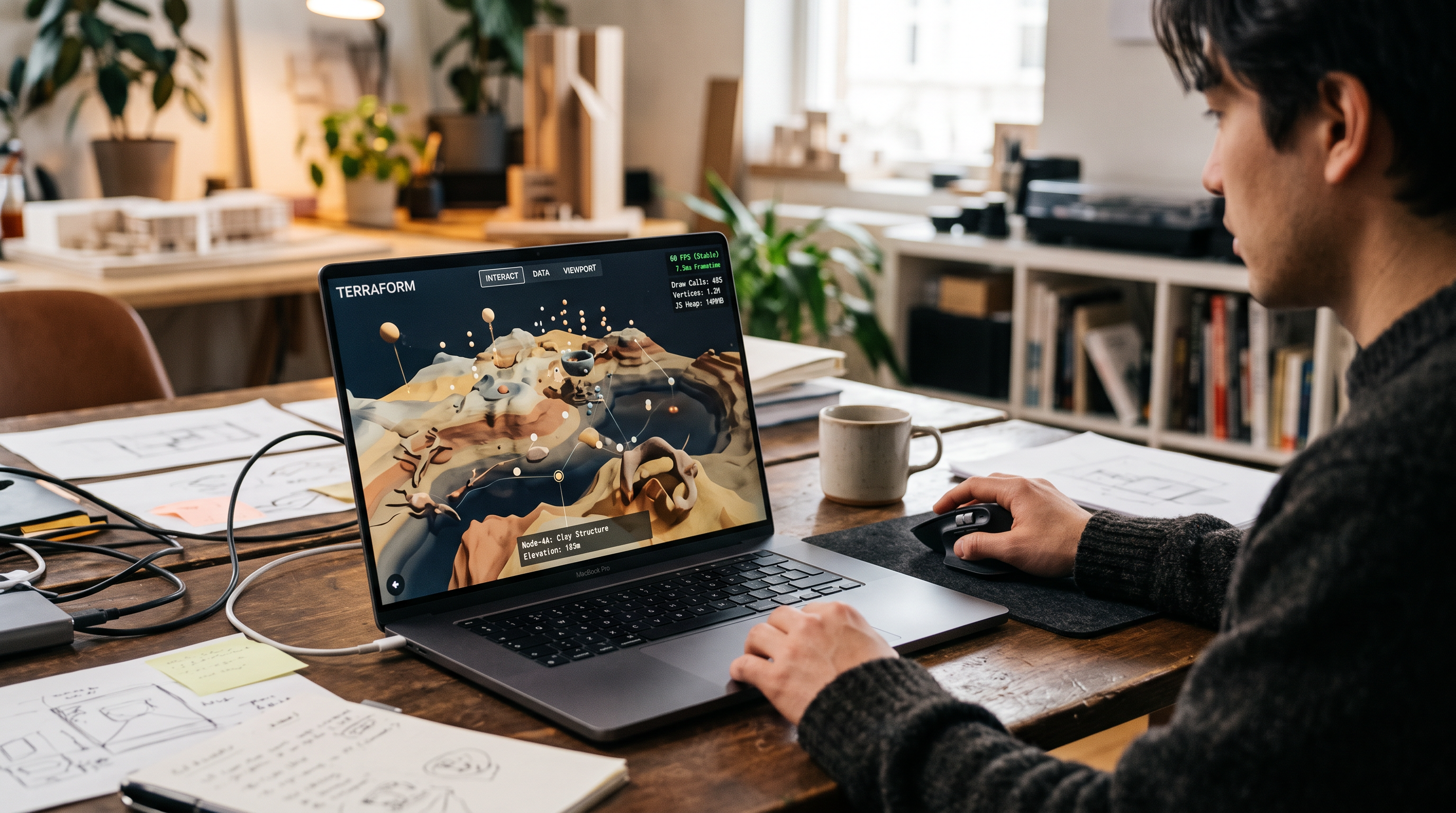
VZU Canvas is the WebGL, three.js, and custom-design-system practice. When the standard surface isn't enough — when the brief calls for a 3D product viewer, a generative art installation, a data-driven visualization, a custom shader, a WebXR experience — VZU Canvas is the practice.
We work with shaders, GLSL, custom render passes, geometry instancing, GPGPU, post-processing chains. We work with three.js, regl, raw WebGL when the brief calls for it. We work with R3F when the brief calls for declarative React. We work with the right tool for the brief, not the tool that's familiar.
VZU Canvas engineers are senior. They know the rendering pipeline, the GPU, the failure modes, the browser quirks. They know what runs at 60fps and what drops frames. They know when to use a post-process and when to bake it into the geometry. The result is a surface that feels alive. The result is a surface that earns its place on the page.
The practice, in pictures
Three things we get right, every time.


 Production
 The proof
Marketplace. A custom marketplace UI with motion-rich browsing.
A custom marketplace UI with motion-rich product browsing, infinite scroll, GPU-accelerated image gallery, and a generative background shader. Built by VZU Canvas in 10 weeks.
- → GPU-accelerated product gallery with 60fps pan/zoom
- → Generative background shader that responds to scroll velocity
- → Custom intersection observer for infinite scroll
- → WebGL fallbacks for low-end devices (auto-detection)
-
10
Weeks to ship
-
60fps
Animation
-
1.2MB
Bundle
-
30+
Custom shaders
The engagement
How we work, end to end.

- Stack
-
three.js + R3F + GLSL
Or raw WebGL. Or regl. Or WebGPU when the browser support catches up.
- Performance
-
60fps minimum, target
Every scene budgeted. Frame time is sacred. LCP under 2.5s.
- Fallbacks
-
Auto-degrade
If the GPU can't handle it, the static image loads. The user always gets something.
- Mobile
-
Touch-optimized
Gesture controls, no hover states, no precision-click UI. Designed for thumbs.
- A11y
-
Reduce motion respected
When prefers-reduced-motion is set, the WebGL fades to the static. Always.
Long-form essay
VZU Canvas.
A working essay.
Why the design canvas is the operator's posture. Why the senior designer with the audit trail is what ships the components that ship the product.
Chapter 01 · The brief
A design canvas, not a Figma file.
VZU Canvas started with a brief from a healthcare operator in Vancouver. 14 clinics. 240,000 patient records. A Figma file that had 4,200 components, 18 versions of the design system, and no source of truth. The operator's design team spent 30% of their time reconciling the Figma file with the production code. The operator's engineering team spent 20% of their time fixing design drift.
The brief from the operator was specific: ship a design canvas. The design tokens. The components. The motion principles. The accessibility posture. A single source of truth. A 6-week ship. A 12-month payback on the design drift.
The hardest part wasn't the design. The hardest part was that the canvas had to be the operator's canvas — not VZU's canvas. The tokens, the components, the motion, the a11y. The operator owns the goal. VZU ships the work. The canvas is the operator's posture: unbound.
Chapter 02 · The work
Astro 5. Tailwind v4. A11y-clean. Mobile-first.
The work is the senior designer who has shipped 50+ production design systems. The work is the designer who knows the difference between a Figma file and a design canvas. The work is the designer who picks the right component, the right variant, the right state — and ships the canvas that ships the product.
We build on Astro 5 + Tailwind v4. The output is a design system. The design system is auditable. The design system is the record. The design system is the work.
We design in three passes. The first pass is the foundation — the tokens, the typography, the color. The second pass is the components — the buttons, the cards, the forms, the navigation. The third pass is the polish — the motion, the a11y, the documentation. The output is a working canvas. The canvas is auditable. The canvas is the work.
“The canvas is the operator's posture. The tokens, the components, the motion, the a11y. The operator owns the goal. VZU ships the work.”
— VZU Canvas, run #1
Chapter 03 · The result
6-week ship. 4,200 components collapsed to 320.
The canvas shipped in 6 weeks. 4,200 components collapsed to 320. The design drift went from 20% to 2%. The design team's reconciliation time went from 30% to 5%. The payback was 8 months.
The canvas is now the operator's primary design source. The canvas is the operator's first impression. The canvas is the operator's first sale. The canvas is the operator's posture.
The brief expanded. VZU Canvas now runs as a quarterly iteration for the operator. Every quarter, new components ship. Every quarter, the design drift is audited. Every quarter, the operator's canvas is the operator's canvas. The canvas is the work. The runtime is the engine. The work is the work.
6wk
to ship · 4,200 → 320 components
Chapter 04 · The why
Why the canvas is the operator's posture, not the designer's.
VZU exists because the seam is the work. VZU Canvas exists because the canvas is the work. The canvas is what turns a brief into a posture. The canvas is what turns a posture into a destination. The canvas is what turns a destination into a legacy.
VZU Canvas is a senior practice. The designers who do the work have shipped 50+ production design systems. They have refreshed hotels, restaurants, law firms, hospitals, schools. They know the difference between a Figma file and a design canvas. They write the canvas so the operator's canvas is the operator's canvas.
VZU Canvas is fixed-fee, fixed-scope, audit-first. The brief is the contract. The work is the work. The canvas is the regulator's form. The audit trail is on from the first character. The seam is the work. VZU ends the seam.

The VZU Canvas practice
The work, in motion.
Every brief becomes a working product in days. Every product is engineered for the long term — clean architecture, real audit trails, real operators in the loop. The VZU Canvas practice at VZU is built on senior engineering, the NetWit runtime, and a refusal to ship anything we wouldn't put on a public domain.
The VZU family